


la peinture en scène
[Exhibition extended until 04.01.26]
Preparatory sketches for stage curtains
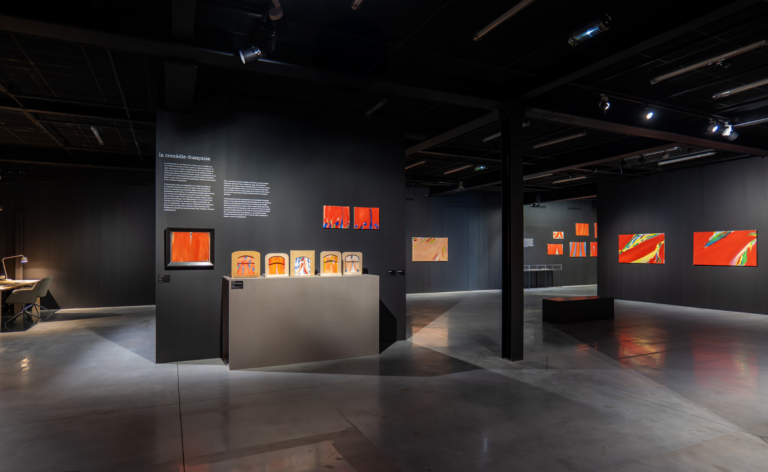
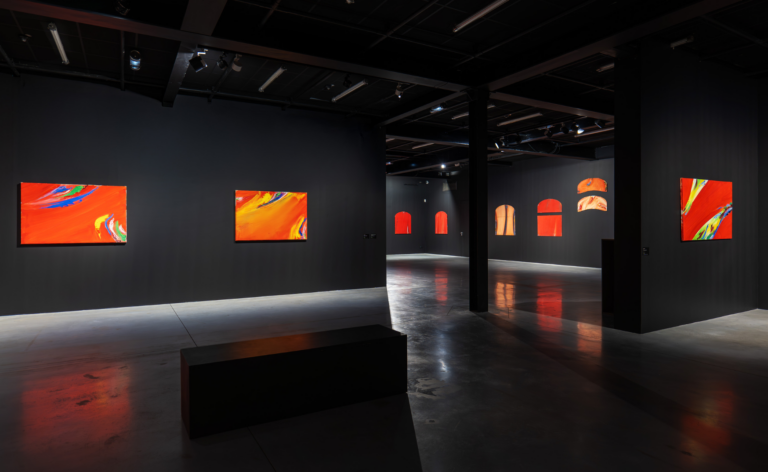
For the first time with la peinture en scène, the works of Olivier Debré are presented not in the white gallery as visitors to the art centre have become accustomed, but in the black gallery—a space that more directly evokes the theatrical atmosphere inherent in the stage curtain.
The exhibition’s layout is structured around four axes representing the four stage curtains created by the artist: the Comédie-Française theatre (Paris, 1987), the Hong Kong Opera (1989), the Théâtre des Abbesses (Paris, 1996), and the Shanghai Opera (1998).
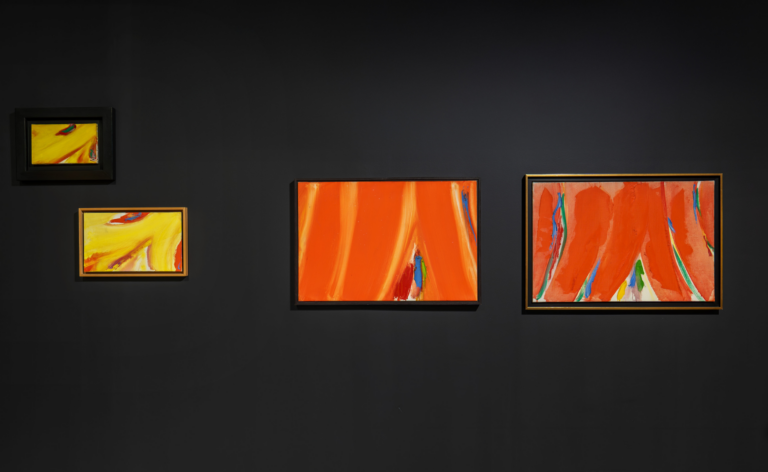
For obvious reasons, the CCC OD will not show the actual stage curtains but will focus on the “maquettes” or “esquisses” created for them. While this exhibition cannot be reduced to a simple game of “find the seven differences,” it naturally offers the opportunity to examine the similarities that persist from one project to another.
The primary aim is to observe the creative process—to study how Debré approaches a commissioned project and conducts aesthetic research that remains deeply personal. The exhibition highlights the distinct characteristics of each of these four commissions as well as their differences.
Among the 60 preparatory works on display, half relate to the Comédie-Française, for which the artist produced about a hundred sketches (compared to around twenty for Shanghai, for example). The exhibition also showcases the individual identity of each curtain, expressed by the artist through very varied chromatic explorations.
This exhibition offers a chance to discover a new dimension of Olivier Debré’s body of work, one that depends less on sensation and landscape and more on a sustained plastic and conceptual reflection required by a specific commission.
olivier debré

(1920 – 1999)
Since the end of 2016, the entire body of works from the Debré Donation—given to Tours Métropole Val de Loire by the artist’s beneficiaries—has been housed at the CCC OD.
Olivier Debré was born in Paris into a family of doctors and artists. He began painting and drawing in childhood, later turning toward a career in architecture. In 1938, he graduated from the École des Beaux-Arts de Paris in the architecture department. He nevertheless chose to devote himself to painting.
Initially influenced by Impressionism, his pictorial language evolved toward more open compositions with broad expanses of color, establishing Debré as one of the representatives of gestural abstraction. Despite numerous travels around the world, he frequently returned to paint along the Loire, in Vernou-sur-Brenne near Tours, at the “Madères” estate where he had set up one of his studios.
Stripped of all anecdotal elements, Olivier Debré’s painting is a painting of space and light. The titles he gives his works evoke an emotion connected to a moment and a place, embodied through a chromatic atmosphere. In this way, we remain very close to landscape—already within a landscape whose limits and horizon extend beyond the frame of the canvas. The viewer thus finds themselves truly at the center of an immense detail.
At the same time, the viewer stands at the heart of the painting itself, to which the seemingly understated titles refer. These titles indeed describe the work as it appears in its materiality: composed of layers and transparencies. It continually asserts itself first and foremost as a painted surface upon which gesture is inscribed. The phenomenon intensifies with scale. Everything becomes painting.
[Exhibition extended until 04.01.26]
Preparatory sketches for stage curtains
For the first time with la peinture en scène, the works of Olivier Debré are presented not in the white gallery as visitors to the art centre have become accustomed, but in the black gallery—a space that more directly evokes the theatrical atmosphere inherent in the stage curtain.
The exhibition’s layout is structured around four axes representing the four stage curtains created by the artist: the Comédie-Française theatre (Paris, 1987), the Hong Kong Opera (1989), the Théâtre des Abbesses (Paris, 1996), and the Shanghai Opera (1998).
For obvious reasons, the CCC OD will not show the actual stage curtains but will focus on the “maquettes” or “esquisses” created for them. While this exhibition cannot be reduced to a simple game of “find the seven differences,” it naturally offers the opportunity to examine the similarities that persist from one project to another.
The primary aim is to observe the creative process—to study how Debré approaches a commissioned project and conducts aesthetic research that remains deeply personal. The exhibition highlights the distinct characteristics of each of these four commissions as well as their differences.
Among the 60 preparatory works on display, half relate to the Comédie-Française, for which the artist produced about a hundred sketches (compared to around twenty for Shanghai, for example). The exhibition also showcases the individual identity of each curtain, expressed by the artist through very varied chromatic explorations.
This exhibition offers a chance to discover a new dimension of Olivier Debré’s body of work, one that depends less on sensation and landscape and more on a sustained plastic and conceptual reflection required by a specific commission.
Sorry, the comment form is closed at this time.