


Debré 1990 : les peintures potentielles
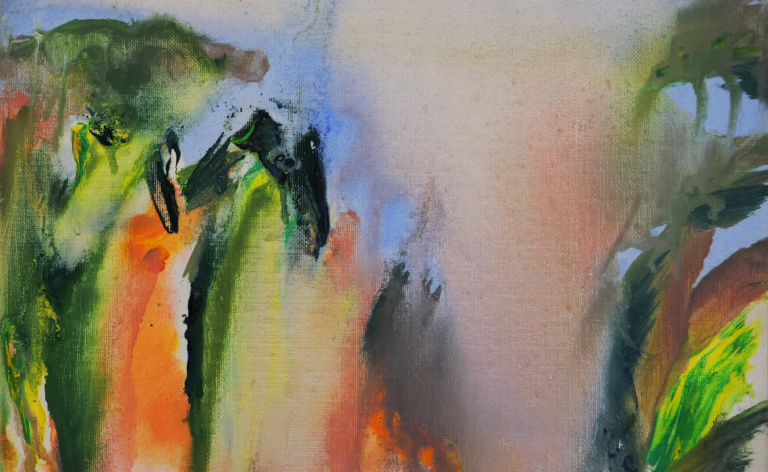
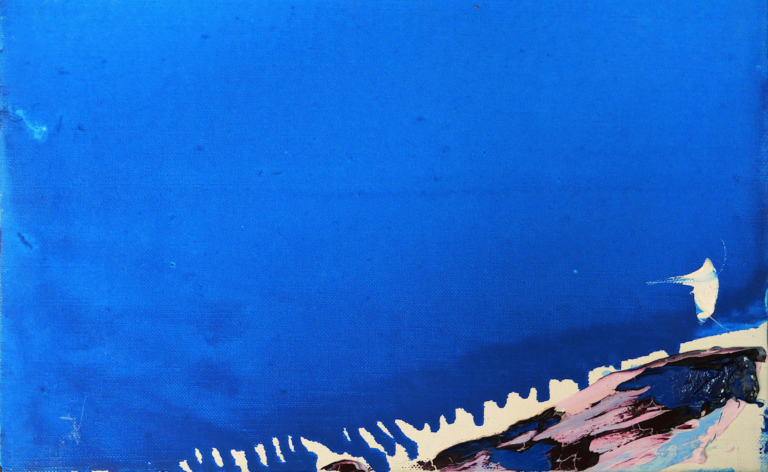
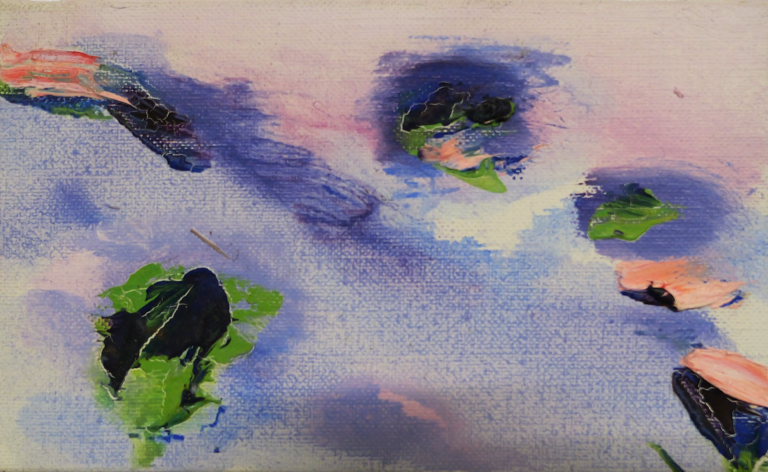
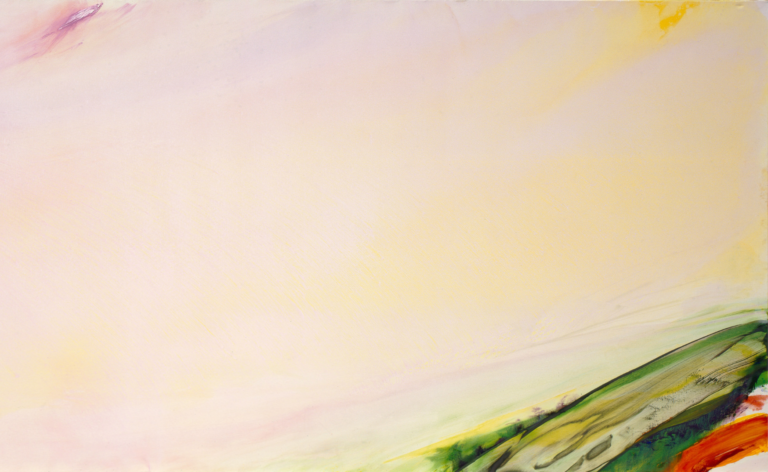
In 2018, the exhibition ‘Les Nymphéas d’Olivier Debré’ brought together at the CCC OD six of the largest canvases ever produced by the artist in 1990–1991.
Today, the art centre wishes to explore these works created on the banks of the Loire by placing them in a broader context alongside other pieces created during the same period (1990–1995), but which are of very different proportions. For whilst we tend to associate Olivier Debré with the monumental scale of his works, we are quick to forget that he was also a tireless explorer who probed the possibilities of his artistic gesture within very small compositions. One need only think, for example, of the postage stamp (3.6 x 4.8 cm), commissioned by the Ministry of Posts in 1992 and issued in 1993, or his small travel sketches, which one discovers almost as if leafing through a sketchbook.
Debré was not merely a painter of large-scale abstract works; the complexity of his work is considerable, as are its unique features. This is true of his smallest canvases – sometimes minuscule – which tell us a great deal about the artist’s creative process and his approach to composition, but which are also more effective from an experimental point of view, as the risk involved is logically less on a twenty-centimetre canvas than on one measuring nine metres. As with a model or prototype, it is easier to explore a wider range of possibilities.
Examining his output over a very short period (1990–1995) reveals the coexistence, at a given time, of numerous concurrent artistic endeavours that are nonetheless fundamentally dissimilar in terms of their compositional approach. These attempts to move away from Loire’s typical composition – a broad, oblique line sweeping down the canvas – are often highly successful and convincing – the vertical divisions in particular; yet the artist cannot resist and always returns, time and again, to the principle of oblique composition, which he undoubtedly regards as the most cohesive and dynamic.
olivier debré
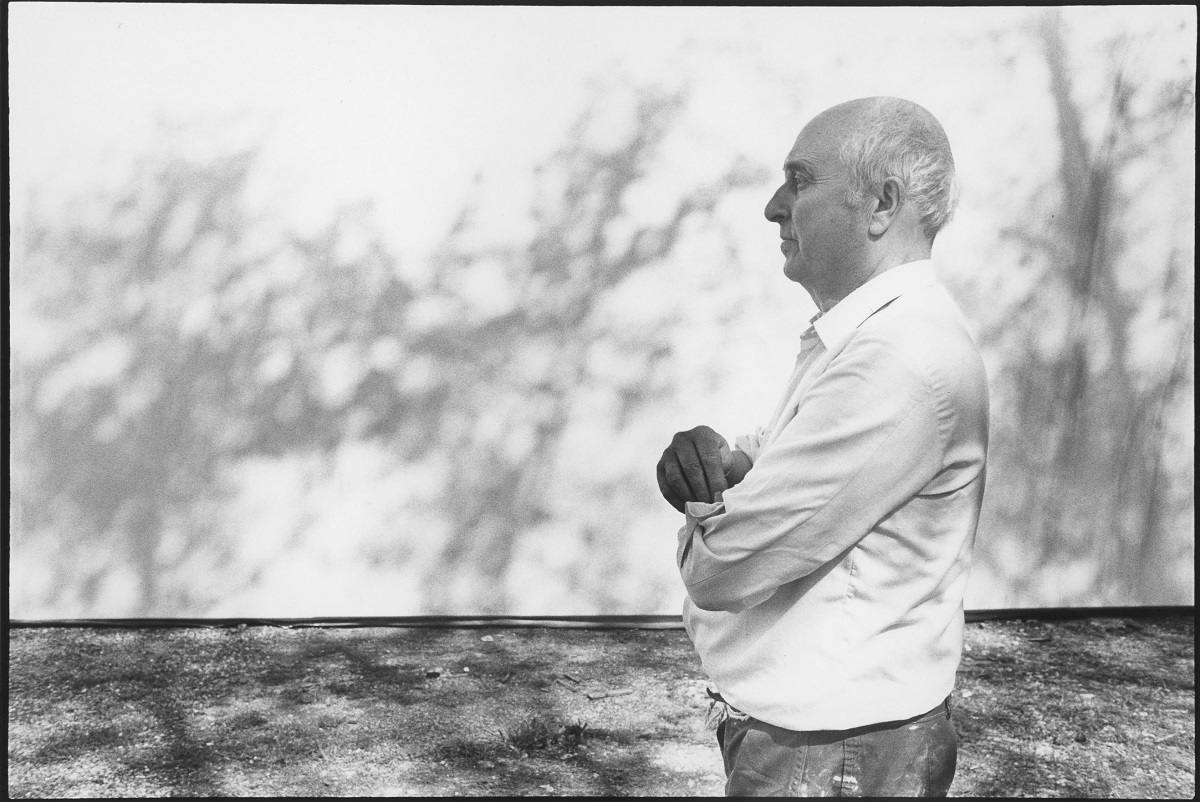
(1920 – 1999)
Since the end of 2016, all the works in the Debré Donation, made to Tours Métropole Val de Loire by the artist’s heirs, have joined the CCC OD.
Olivier Debré was born in Paris into a family of doctors and artists. He began painting and drawing as a child, and then turned to a career in architecture. In 1938, he graduated from the Paris School of Fine Arts in the architecture section. However, he decided to devote himself to painting.
His pictorial expression, initially inspired by Impressionism, evolved towards more open compositions with large areas of colour, making Debré one of the exponents of gestural abstraction. Despite travelling extensively around the world, he often returned to paint near the Loire, at Vernou-sur-Brenne, near Tours, in the “Madères” estate where he had set up one of his studios.
Stripped of all anecdote, Olivier Debré’s painting is a painting of space and light. The titles he uses are the evocative expression of an emotion linked to a moment, a place and embodied by a chromatic atmosphere. In this way, we are very close to the landscape, and already in the landscape, whose limits and horizon have been pushed beyond the field of the painting. The viewer is thus truly at the centre of an immense detail.
But they are also at the centre of the painting to which the deceptively innocuous titles refer. They describe it as it appears in its materiality: all thickness and transparency. It never ceases to assert itself first and foremost as a painted surface on which the gesture is inscribed. The phenomenon increases with the format. Everything is painting.
In 2018, the exhibition ‘Les Nymphéas d’Olivier Debré’ brought together at the CCC OD six of the largest canvases ever produced by the artist in 1990–1991.
Today, the art centre wishes to explore these works created on the banks of the Loire by placing them in a broader context alongside other pieces created during the same period (1990–1995), but which are of very different proportions. For whilst we tend to associate Olivier Debré with the monumental scale of his works, we are quick to forget that he was also a tireless explorer who probed the possibilities of his artistic gesture within very small compositions. One need only think, for example, of the postage stamp (3.6 x 4.8 cm), commissioned by the Ministry of Posts in 1992 and issued in 1993, or his small travel sketches, which one discovers almost as if leafing through a sketchbook.
Debré was not merely a painter of large-scale abstract works; the complexity of his work is considerable, as are its unique features. This is true of his smallest canvases – sometimes minuscule – which tell us a great deal about the artist’s creative process and his approach to composition, but which are also more effective from an experimental point of view, as the risk involved is logically less on a twenty-centimetre canvas than on one measuring nine metres. As with a model or prototype, it is easier to explore a wider range of possibilities.
Examining his output over a very short period (1990–1995) reveals the coexistence, at a given time, of numerous concurrent artistic endeavours that are nonetheless fundamentally dissimilar in terms of their compositional approach. These attempts to move away from Loire’s typical composition – a broad, oblique line sweeping down the canvas – are often highly successful and convincing – the vertical divisions in particular; yet the artist cannot resist and always returns, time and again, to the principle of oblique composition, which he undoubtedly regards as the most cohesive and dynamic.
Sorry, the comment form is closed at this time.